
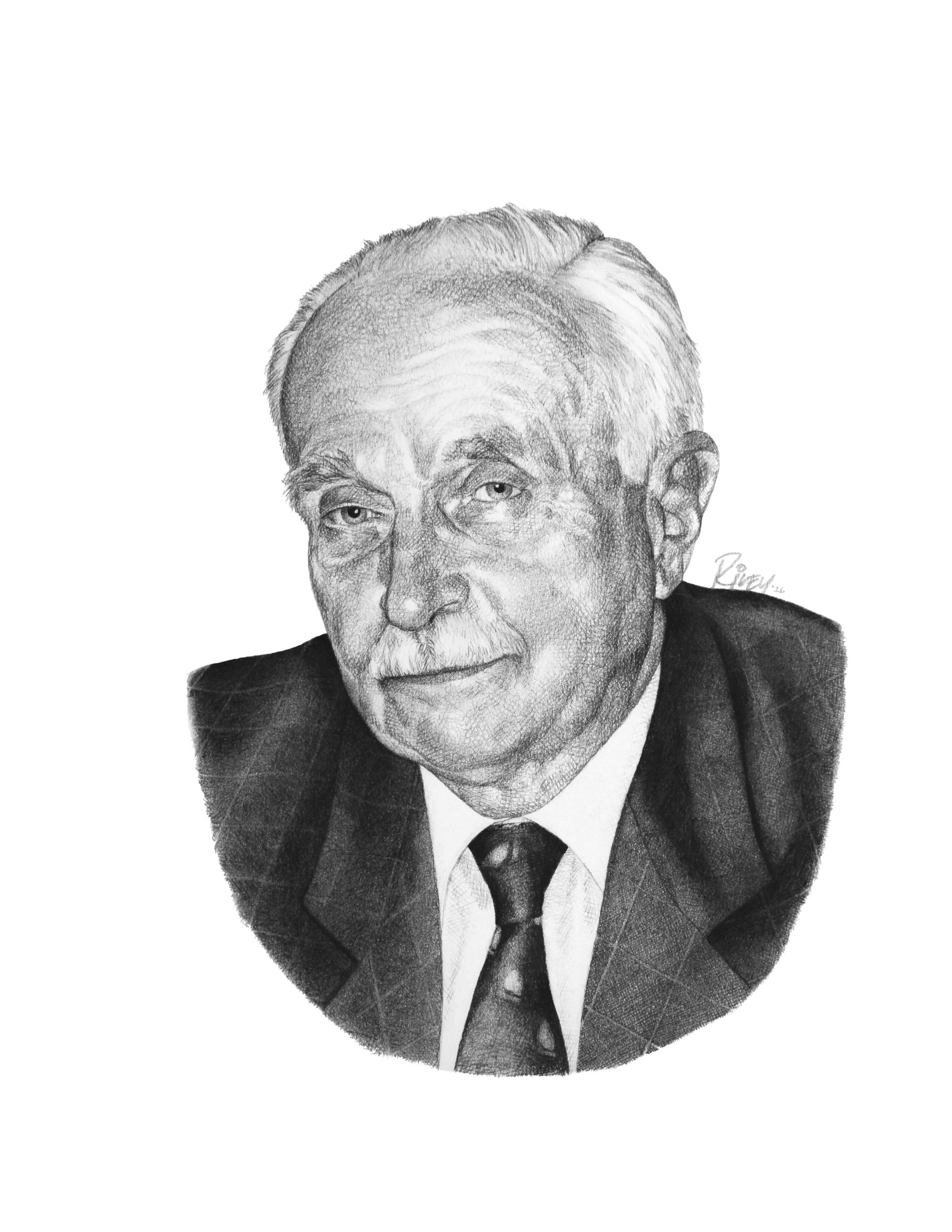
Kenneth Molson
Birth Date: October 13, 1916
Birth Place: Montreal, Quebec
Date of Death: January 6, 1996
Year Inducted: 2026
For his lifetime commitment to aviation in Canada, in a career spanning from the pioneer days to the 1990s, which notably included work as the founding curator of the national aviation museum and decades long contributions to Canada’s aviation history, Kenneth Molson was inducted into Canada’s Aviation Hall of Fame at ceremonies held in 2026.
When he died in 1996, Kenneth Meredith Molson was the de facto dean of Canadian aviation history; he had spent his life in the field, from bush flying in the 1930s, to years in business and manufacturing, to service as the first curator of the National Aviation Museum.
Born 13 October 1916, Ken’s early years were comfortable. His, after all, was a branch of one of Canada’s storied families. But life was not always easy. He lost both parents when still young and came of age during the Great Depression.
Ken was educated at Montreal’s Selwyn House School, at Ashbury College in Ottawa, and at Westmount High School in Westmount, Quebec. He then began undergraduate studies at McGill University but left after two years to pursue aviation at the Boeing School of Aeronautics in Oakland, California.
His interest in aircraft had started when he was ten years old building model planes. This continued to be his main focus until 1932-33, when he “entered the real world of aviation”. Ken’s flying instruction began in September 1933 at the Curtiss-Reid Flying Service at Cartierville, Quebec, flying Curtiss-Reid Ramblers; he soloed in CF- ACI in 1936, receiving his private pilot’s license that same year (while flying the Montreal Light Aeroplane Club’s de Havilland D.H. 60 Moth). In the summers, he worked for his cousin Hartland as a mechanic for Dominion Skyways, which flew out of Senneterre.
In September 1938, Ken joined the aircraft division of the National Steel Car Corporation at Malton, Ontario, which became Victory Aircraft in 1942. He began in the production department and then moved to inspections, before joining the engineering division. During this time, he participated in the following aircraft programs: Westland Lysander, Martin B-26B (not built), Avro Anson II, Avro Lancaster X and XPP, and the Avro Lincoln XV.
Ken moved directly from Victory Aircraft to A.V. Roe Canada at the beginning of December 1945, where he was again employed in the engineering department. He remained with the company until retiring in 1959. While with Avro, he worked by his own account on conversions of Lancaster Xs and Lockeed Venturas for the RCAF, on the C-102 Jetliner (albeit only briefly), and on both the CF-100 Canuck and CF-105 Arrow until the latter’s cancellation the same year he retired.
While in Malton, Ken joined the Toronto branch of the Canadian Aeronautical Institute. Horace Luttnam (CAHF, 2009) later described him as being “one of our active members.” In time he joined the Institute’s Silver Dart Committee, which planned to lead the construction of a replica Silver Dart to mark the 50th anniversary of powered flight in Canada. The plan was scrapped, however, after the committee learned that the RCAF had also successfully started to build a flying replica (it now resides at the Canada Air and Space Museum in Ottawa).
It was around this time that Ken began to contribute historical articles to the CAI’s Canadian Aeronautical Journal, including a lengthy analysis of aircraft manufacturing in Canada during the First World War. He had always been interested in the development of Canadian aviation and had photographed many aircraft during his early days in the 1930s. He had also begun collecting a photographic record of early Canadian aviation efforts and, with his retirement from Avro, he became increasingly involved in Canada’s aviation history; an August 1960 note in the National Post shared that he had started work on a history of the country’s aviation industry.
Need for a national aviation museum had been widely acknowledged since the mid-1950s and as planning for it progressed Ken was a natural fit for such an institution. He was hired as the museum’s first curator ahead of its formal opening in 1960 at the Uplands terminal and, heading up a small team that took its initial cue from both the National Research Council’s John Parkin and Malcolm Kuhring, began planning exhibits and developing displays. The real work began after the museum’s formal opening that October, when the NAM team immediately started to build up the collection and resources; Ken became a founding member of the Aviation sub-committee of the International Association of Transport Museums to profit from international expertise.
The genesis of the museum’s scholarly material was the NRC technical reference library, but there was little on hand relating to the history of aviation. Several important donors helped to correct this, one of whom was the Institute of Aeronautical Sciences in New York, which offered some 600 duplicates from its collection. Ken managed to secure as well the library of the former Austro-Hungarian Aero-Technical Society, a rich pioneering aviation collection. He also commissioned aviation artist Robert Bradford (CAHF, 1996) to produce a series of paintings of key aircraft (Bob would later join the museum as assistant curator and eventually succeed Ken upon his retirement).
On the museum floor at Uplands, Ken worked to expand aircraft holdings. Notable additions acquired during his tenure included an excellent example of a Curtiss JN-4 Canuck, a Bellanca CH-300 Pacemaker, and a Junkers W34. He lamented that no examples of a Vickers Vedette or Armstrong Whitworth Siskin had survived, but he did help to secure a Sopwith Snipe, a French SPAD VII, and an Avro 504K. Other important types to join the museum included a Fairchild 82A, FC-2W2, and a Fleet 50, the latter being a salvage operation. Perhaps the major achievement during the museum’s first few years was the successful integration of separate aircraft collections overseen by the Canadian War Museum, the National Aviation Museum, and the Department of National Defence in the National Aeronautical Collection. It remains the heart of today’s Canada Aviation and Space Museum.
Ken retired from the museum in 1967 ahead of it becoming part of the National Museum of Science and Technology. He immediately dove headlong into furthering his research and writing of Canada’s aviation history. As one of the early founders of the Canadian Aviation Historical Society (CAHF, 2001), his contributions to its journal during the 1960s and 1970s were prolific; he often produced multiple articles per year. In fact, between 1963 and his death, he authored some 50 pieces for the journal, be these drawings, short aircraft profiles, or well-researched historical articles.
His initial foray into longer articles for the journal was in the Winter 1964. “The McKee Flight”, was an account of the first solo trans-Canada flight flown by J. Dalzell McKee, after whom the McKee Trophy is named. He also authored a history of Martinsyde aircraft in Canada and Newfoundland, a piece that included reference to what he supposed were the first efforts at bush flying in Canadian history.
Ken could also write corrective pieces, like his article, “Prewar Civil Colours,” which acknowledged that most work on markings was concerned with military aircraft, not civil machines. It proceeded to lay out the practice of covering and doping aircraft, providing important analysis of the livery of key Canadian companies, including Canadian Airways, Dominion Skyways, Laurentide Air Services, and Western Canada Airways, among others.
More impressive than his many articles is the sheer scope of his interest. Ken was equally capable of deeply researched and detailed lists of pilots or aircraft histories as he was able to tell gripping tales of early pioneers. Remark-ably, he did this for all eras of Canadian aviation history, be his subject the introduction of the aileron, early flying along the Mackenzie River, or aircraft production during the Second World War. His longest articles included his history of the New York–Toronto Air Race, a profile of Fairchild monoplanes, the aforementioned piece on bush flying along the Mackenzie, a profile of Laurentide Air Service, and a two-part history of Jack Elliot’s air service. The same breadth of interest and keen attention to detail is evident in his books: 125 Years of Canadian Aeronautics: A Chronology, 1840-1965 (co-written with George Fuller and John Griffin), Pioneering in Canadian Air Transport, Canadian Aircraft since 1909 (co-written with H. A. Taylor), and his history of the National Aviation Museum, Canada’s National Aviation Museum, produced for the opening of its new facility in 1988.
When not writing up new histories during these first years, Ken was updating CAHS members on programs run by the National Aviation Museum, like its model aircraft collection, or furthering work he had begun while still curator, such as his profile of Curtiss “H”-Boats, the HS-2L especially. This type, of course, had eluded Ken while he was with the museum, although he helped kickstart the search, which led to one’s eventual salvage in 1968. He paid this aircraft special attention in his co-authored book with A. J. Shortt, The Curtiss HS Flying Boats, documenting the recovery, restoration, and eventual display of G-CAAC at the museum.
Around the time of the NAM opening, Ken summed up his interest in aviation: “While my aviation career extended from the wire braced, fabric-covered, biplanes of the late 1920s to the supersonic CF-105[,] my present main interest lies with the early days and their aircraft. As I have said in recent years – my interest in aircraft is inversly [sic] proportional to the thickness of their skins.” Thin though they were, we have Ken to thank for helping to build them into a solid foundation – one for which the research, writing, and preservation and display of Canada’s aviation history was further strengthened by donation of Ken’s archive, including his remarkable photograph collection, to the CASM after his death. The museum’s Kenneth M. Molson lecture series is named in his honour, a fitting tribute for one who did so much for the history of Canadian aviation.
Ken Molson- 2026 Inductee
To return to the Inductee Page, please click here.